Contents
- What Exactly Is the Schengen Visa Digitalization?
- How Does This Affect Indian Applicants in the US and Philippines?
- What Changes Are Already Live in 2026?
- Do You Still Need a Full Document File in 2026?
- Biometrics in a Digital World: What Changes, What Stays
- How to Monitor for Digital Portal Activation at Your Consulate
- Quick Reference: 2026 Application Channels by Applicant Group
- Practical Advice: Apply Under the Current System Without Delay
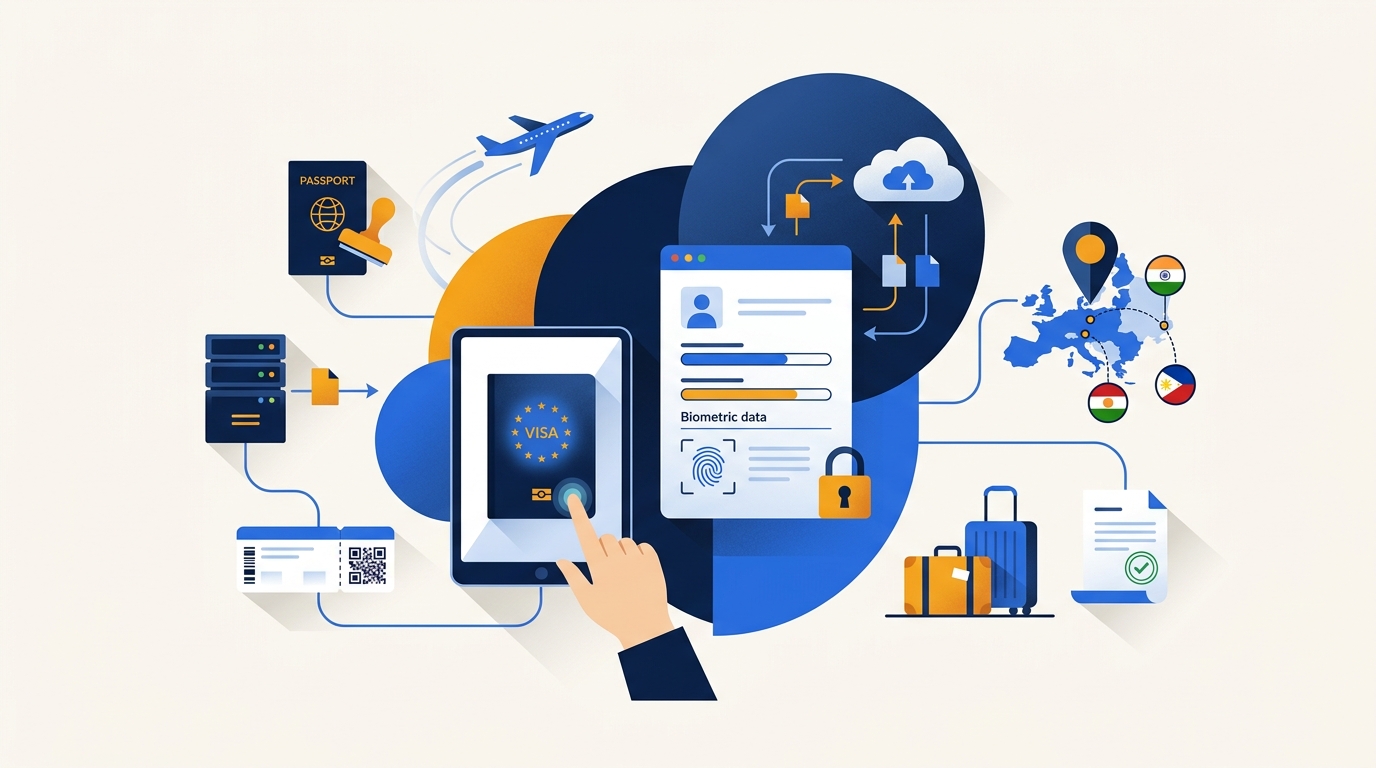
The European Union is actively digitalizing the Schengen visa application process: as of 2026, several member states have begun piloting an online application portal that allows applicants — including Indian nationals in the US and Filipino citizens in the Philippines and the US — to submit forms and supporting documents digitally, with in-person biometric collection remaining mandatory only at an accredited visa application center. This shift does not eliminate your document file, but it changes the format in which you submit it and, critically, the order of steps you must follow.
- The EU's digital Schengen visa portal is in phased rollout; not every consulate or member state has activated it yet — check the specific consulate's website before you begin your application.
- Biometric data (fingerprints and photograph) must still be given in person at a VFS Global or BLS International center; no consulate accepts remote biometrics.
- Supporting documents — including bank statements, flight itineraries, hotel bookings, and insurance — are still required; digital submission does not reduce the document burden.
- Indian and Filipino applicants based in the US apply through the consulate of the main-destination Schengen country, regardless of whether that country has activated the digital portal.
- The standard Schengen visa fee for adults is €80 (approximately $87 USD at mid-2025 rates); check the relevant consulate's current fee schedule for the latest converted amount.
What Exactly Is the Schengen Visa Digitalization?
In 2019, the EU passed Regulation (EU) 2019/1155, which updated the Visa Code and mandated that the Commission develop a digital application platform for Schengen visas. The goal is to let applicants fill in the visa application form online, upload scanned supporting documents, and pay fees electronically — rather than walking into a visa application center with a paper file on day one.
As of 2026, the rollout is gradual. A handful of member states — including France and the Netherlands — have begun internal testing with limited applicant groups. A fully harmonized, EU-wide platform accessible to all nationalities is expected later in the decade; the Commission has not fixed a hard launch date for universal access. What this means in practice: most Indian and Filipino applicants will still use the traditional paper-and-VAC process in 2026, but should monitor the consulate of their target country for any portal activation.
Importantly, the digitalization applies to the application submission step only. The Schengen Visa Code still requires biometric data for first-time applicants and applicants whose biometrics are more than 59 months old. That in-person step at VFS Global or BLS International is not going away under the current framework.
How Does This Affect Indian Applicants in the US and Philippines?
Indian nationals living in the United States apply through the Schengen consulate of their main destination country, which is located in the US. For example, a trip to Germany means applying through the German consulate (usually handled via VFS Global). Indian citizens living in the Philippines apply through the relevant Schengen consulate in Manila or through an accredited VAC there.
For both groups, the digital portal question comes down to one thing: has the consulate you are applying to activated an online submission option? As of early 2026, most Schengen consulates serving Indian applicants in the US still use the traditional paper-based process through VFS Global. You fill in the Schengen application form (the standard two-page form), print it, sign it, and submit it at your VAC appointment along with your physical document file.
The practical implication: do not delay your application waiting for a digital portal. Apply through the current channel — VFS Global or the consulate's designated VAC — and build your document file to the existing standard. When a digital portal is activated for your specific consulate, the consulate will announce it on its official website and through VFS/BLS communications.
- Indians in the US: use VFS Global (Germany, France, Italy, Spain, etc.) or the consulate's own appointment system (Switzerland uses TLS Contact in some cities).
- Indians in the Philippines: apply through the relevant Schengen member state's consulate in Manila; VFS Global Philippines handles several EU member states.
- Filipinos in the US: apply through the consulate of the main-destination country in the US, typically via VFS Global or BLS International.
- Filipinos in the Philippines: apply through the relevant consulate in Manila or Cebu, with VFS Global Philippines managing appointments for several countries.
What Changes Are Already Live in 2026?
Even before a universal digital portal exists, several concrete changes are already in effect in 2026 that every Indian and Filipino applicant must know.
| Change | Status in 2026 | Impact on Applicants |
|---|---|---|
| Schengen visa fee increase to €80 for adults | In force since June 2024 | Higher cost; check consulate for USD/PHP equivalent at time of application |
| EES (Entry/Exit System) launch | Delayed; expected later in 2026 — monitor eu-LISA announcements | Will replace passport stamps; biometric border checks at Schengen entry/exit |
| ETIAS (EU Travel Information and Authorisation System) | Delayed pending EES launch; not active as of mid-2026 | Will apply to visa-exempt travelers; Indian and Filipino nationals with Schengen visas are not affected — the visa IS your authorization |
| Digital Schengen portal (full rollout) | Pilot phase only; not universally available | Most applicants still submit paper files at VAC centers in 2026 |
| Extended biometric reuse window | In force — biometrics valid for 59 months | Returning applicants whose biometrics are within 59 months do not need a repeat biometric appointment |
| VFS Global fee adjustments | Varies by country and city | Service fees on top of the €80 visa fee; check VFS Global's current schedule for your city |
The EES delay is significant news for 2026 travelers. EES will register every non-EU national's entry and exit from the Schengen zone electronically, replacing manual passport stamping. It does not require any action from visa applicants during the application stage, but once live, it will make overstaying a Schengen visa far easier to detect. Indian and Filipino applicants should ensure they plan itineraries that strictly respect the 90-days-in-180-days rule.
Do You Still Need a Full Document File in 2026?
Yes — unambiguously. The digitalization of the submission channel does not reduce the documentary evidence required by the Schengen Visa Code. Every consulate still evaluates your application against the same checklist of supporting documents, whether you upload them online or hand them over at a VAC counter.
For Indian and Filipino applicants, the document file typically includes: a confirmed flight itinerary (not necessarily a purchased ticket, but a reservation showing your name, dates, and flight numbers), proof of accommodation for every night of the trip, travel insurance covering the entire Schengen zone with a minimum coverage of €30,000, bank statements for the past three to six months, proof of employment or business registration, and a cover letter explaining the trip's purpose.
One common misconception fueled by the 'digitalization' news cycle: some applicants believe that moving to an online process means consulates will do less document review. The opposite is true — digital submission means your documents are time-stamped, logged, and easier to cross-reference. Weak files are flagged faster, not slower. Build a complete, consistent file every time.
- Flight itinerary: a PNR-confirmed reservation showing entry and exit from the Schengen zone, matching your stated travel dates.
- Hotel bookings: confirmation for every night, in the name of the applicant, showing the property address.
- Travel insurance: minimum €30,000 coverage, valid in all 27 Schengen member states, for the full trip duration.
- Bank statements: three to six months, showing consistent balance and regular income; avoid large unexplained deposits immediately before application.
- Cover letter: explains your itinerary, purpose, ties to your home country or US residence, and why you will return.
- Employment proof: employment letter on company letterhead (for salaried applicants), or business registration and recent tax returns (for self-employed).
SchengenFile prepares complete Schengen visa document files — including a confirmed flight PNR, hotel bookings, travel insurance, and a personalized cover letter — so your application is ready to submit whether your consulate still uses a paper VAC process or has activated an online portal. Visit schengenfile.com to get started.
Biometrics in a Digital World: What Changes, What Stays
Even when a consulate fully activates digital application submission, biometric collection remains an in-person requirement under the current Schengen Visa Code. For Indian and Filipino applicants who have never applied for a Schengen visa before, or whose previous biometrics are older than 59 months, a physical appointment at a VAC is non-negotiable.
The practical workflow under a digital portal — when it goes live for your consulate — will likely be: (1) complete and submit the application form online, (2) upload supporting documents via the portal, (3) pay the fee online, and (4) attend a brief in-person appointment at a VFS Global or BLS International center solely for biometric collection. The 'appointment' becomes shorter and more focused, but it does not disappear.
For applicants whose biometrics are within the 59-month validity window, the future digital process is most favorable — you may be able to complete the entire process without any in-person visit, depending on the consulate's implementation. This is the scenario the EU is eventually aiming for, but it is not standard practice at any Schengen consulate serving Indian or Filipino applicants as of 2026.
How to Monitor for Digital Portal Activation at Your Consulate
Because the rollout is country-by-country and sometimes even consulate-by-consulate, the most reliable way to know whether a digital application option is available to you is to check the official website of the Schengen member state's embassy or consulate in your country of application. Do not rely on third-party travel forums or news articles for this — activation can happen with short notice, and unofficial sources lag behind.
- Go to the official embassy or consulate website of the Schengen country you are applying to (e.g., the French Consulate General in New York, or the German Embassy in Manila).
- Look for a 'Visa Applications' or 'How to Apply' section — any digital portal link will appear there.
- Check your designated VAC provider's website (VFS Global at vfsglobal.com, BLS International at blsinternational.com, or TLS Contact) for service updates specific to your country pair.
- Sign up for email alerts from VFS Global or your VAC provider — they typically notify registered users of process changes.
- Check the EU's official Schengen visa information page (ec.europa.eu/home-affairs) for policy-level announcements about the digital platform rollout.
For Indian applicants in the US applying for a Germany Schengen visa, VFS Global USA is the primary contact point and will update its booking system when a digital pre-submission option becomes available. The same applies for Filipino applicants reviewing the Schengen visa application steps for Filipino citizens in the US.
Quick Reference: 2026 Application Channels by Applicant Group
| Applicant Profile | Where to Apply | VAC Provider (Typical) | Digital Submission Available? |
|---|---|---|---|
| Indian national, living in USA | Schengen consulate of main-destination country in the US | VFS Global USA (most countries); TLS Contact (Switzerland in some cities) | Not yet for most consulates — check individual consulate website |
| Indian national, living in Philippines | Schengen consulate of main-destination country in Manila | VFS Global Philippines | Not yet — check individual consulate website |
| Filipino citizen, living in USA | Schengen consulate of main-destination country in the US | VFS Global USA or BLS International USA | Not yet for most consulates — check individual consulate website |
| Filipino citizen, living in Philippines | Schengen consulate in Manila or Cebu | VFS Global Philippines; some consulates take direct appointments | Not yet — check individual consulate website |
Practical Advice: Apply Under the Current System Without Delay
The single biggest mistake applicants make when major Schengen process changes are announced is waiting — hoping the new system will be simpler. In practice, the digitalization rollout has been slower than EU timelines projected, and any new portal will have an adjustment period during which appointment slots may be scarce and processing times unpredictable. If you need a Schengen visa in 2026, apply now under the system currently in place.
Schengen consulates recommend applying no earlier than six months before your trip and no later than 15 working days before your intended departure date. Given appointment slot shortages at VFS Global locations in major US cities and at consulates in Manila, building in eight to twelve weeks of lead time is prudent for most Indian and Filipino applicants in 2026.
Ensure your document file is complete before you book your VAC appointment. Submitting an incomplete file — particularly missing travel insurance that meets the €30,000 minimum, or a hotel booking that does not cover every night — is one of the leading causes of Schengen visa refusals and wasted appointment slots.
Can I apply for a Schengen visa online in 2026?▾
Full online Schengen visa application is not yet available to most Indian and Filipino applicants in 2026. The EU is rolling out a digital portal in phases, but most consulates — including those serving applicants in the US, India, and the Philippines — still require a physical appointment at a visa application center such as VFS Global or BLS International to submit your documents and provide biometrics.
Does the Schengen digitalization mean I need fewer documents?▾
No. The Schengen Visa Code's document requirements — bank statements, flight itinerary, hotel bookings, travel insurance with at least €30,000 coverage, employment proof, and a cover letter — remain unchanged. Digitalization affects how you submit documents, not which documents are required.
Will ETIAS affect Indian and Filipino applicants who already need a Schengen visa?▾
No. ETIAS is a travel authorization for nationals who currently enter the Schengen zone visa-free. Indian and Filipino citizens are not visa-exempt — they already need a Schengen visa, which serves as their entry authorization. ETIAS will not add any extra step for them.
How do I know if the digital Schengen visa portal is available at the consulate I am applying to?▾
Check the official website of the embassy or consulate of the Schengen country you are applying to, as well as your designated VAC provider's website (VFS Global, BLS International, or TLS Contact). Activation is announced country by country; unofficial sources are not reliable for this.
Do I still need to go in person for biometrics if the digital portal is available?▾
Yes, in most cases. Even where a digital application portal has been activated, biometric collection (fingerprints and photograph) still requires an in-person visit to an accredited visa application center for first-time applicants or those whose biometrics are older than 59 months. Only applicants with valid biometrics on file within the 59-month window may eventually be able to skip the in-person step, depending on the consulate's specific implementation.