Contents
- Can Indian citizens in the Philippines apply for a Schengen visa locally?
- Which Schengen consulate in Manila handles your application?
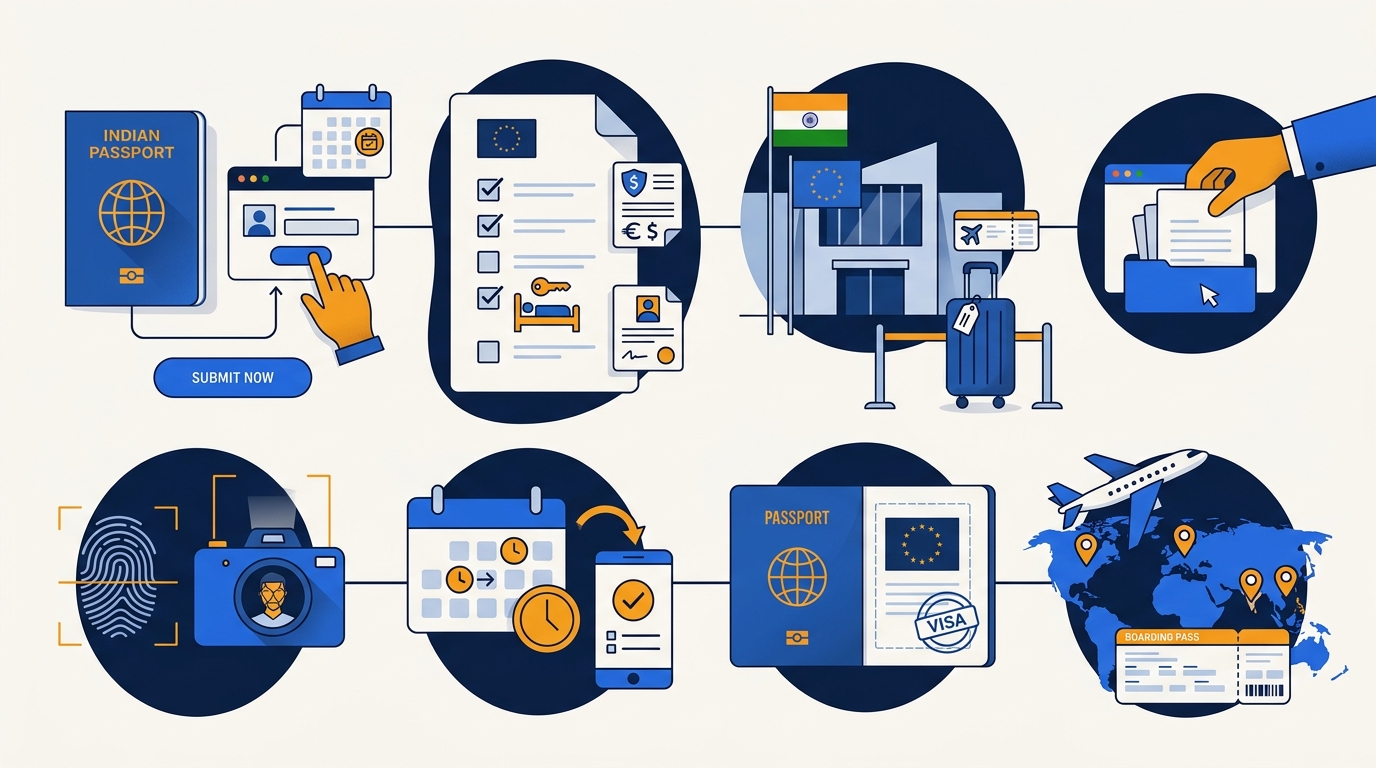
- Step-by-step application process for Indian citizens in the Philippines
- Document checklist: what Indian residents of the Philippines must submit
- Financial requirements: how much money do you need to show?
- Processing times and what to expect after submission
- Common mistakes Indian applicants in the Philippines make
Indian citizens living in the Philippines must apply for their Schengen visa at the competent Schengen consulate in Manila — not at a consulate in India — as long as they hold a valid Philippine residence permit. This means your jurisdiction is the Philippines, and you will submit your application through Manila-based consulates or their appointed visa application center (most commonly VFS Global), following Philippine-specific document requirements and appointment queues that are entirely separate from India-based processes.
- Indian citizens with a valid Philippine residence permit (e.g., 9G work visa, ACR I-Card) apply for Schengen visas in Manila, not India.
- The standard adult Schengen visa fee is €80 (approximately ₱4,800–₱5,000 at current rates) — check the specific consulate's fee schedule for the latest equivalent in Philippine pesos.
- Most European consulates in Manila delegate applications to VFS Global — book appointments directly on the VFS Global Philippines portal.
- Travel insurance covering at least €30,000 in medical/repatriation costs is mandatory for every Schengen visa application.
- Apply no earlier than 6 months and no later than 15 calendar days before your intended travel date.
- Processing time in Manila typically runs 15 calendar days but can extend to 30 or 60 days in complex cases — plan ahead.
Can Indian citizens in the Philippines apply for a Schengen visa locally?
Yes — and in most cases, you are required to apply locally. Schengen rules state that applicants should apply at the consulate of the country with jurisdiction over their place of legal residence. If you live and work in the Philippines on a valid residence permit, you are legally resident there, and the Schengen consulates in Manila are the correct venue for your application.
Your qualifying Philippine residence document is typically one of the following: a 9G employment visa with an Alien Certificate of Registration Identity Card (ACR I-Card), an SRRV (Special Resident Retiree's Visa), or another long-term Philippine visa category. A tourist visa or a visa-on-arrival stamp does not establish legal residence and generally does not qualify you to apply in the Philippines.
If you are in the Philippines temporarily — on a business trip or holiday — and you normally reside in India or the United States, you should apply through your country of legal residence. When in doubt, contact the relevant consulate in Manila before booking an appointment.
Which Schengen consulate in Manila handles your application?
The 'competent consulate' is determined by your main destination — the Schengen country where you will spend the most nights. If nights are equal, it is the country of your first entry. This is a standard Schengen rule, and it applies regardless of your nationality.
All major Schengen member states have consular representation in Manila. The most frequently visited for Indian travelers are France, Germany, Italy, Spain, the Netherlands, and Greece. Most of these have outsourced application intake to VFS Global Philippines, though a few smaller missions may handle appointments in-house. Always verify directly on the consulate's official website before booking.
| Destination Country | Visa Application Center in Manila | Notes |
|---|---|---|
| France | VFS Global Philippines | Applications via VFS Manila; biometrics collected at VFS center |
| Germany | VFS Global Philippines | Appointment booking through VFS portal; some categories handled directly |
| Spain | VFS Global Philippines | High demand — book as early as the consulate's window allows |
| Italy | VFS Global Philippines | VFS Global manages intake; consulate makes final decision |
| Netherlands | VFS Global Philippines | Online appointment system; document checklist on VFS site |
| Greece | VFS Global Philippines | VFS Global for most visa categories |
| Portugal | VFS Global Philippines | Check VFS portal for current appointment availability |
| Switzerland | TLS Contact / VFS (verify) | Confirm current VAC arrangement on the Swiss consulate Manila website |
Appointment slots at popular consulates — especially Spain and France — can be tight in peak travel months (April–September). Check the VFS Global Philippines website (ph.vfsglobal.com) regularly, as cancellations create openings. Setting up a VFS account and enabling notifications can save you days of manual checking.
Step-by-step application process for Indian citizens in the Philippines
The process follows a predictable sequence. Understanding each step in order prevents the most common mistakes — wrong forms, missing documents, or applying at the wrong consulate.
- Confirm your main Schengen destination and identify the competent consulate in Manila.
- Visit the consulate's official website and download the current document checklist for your visa type (tourist/C visa, business, etc.).
- Complete the Schengen visa application form online at the official EU Visa Application Portal (visas.euvisa.eu) or on the specific consulate's designated platform, then print and sign it.
- Gather all required documents (see the checklist section below).
- Book your appointment through VFS Global Philippines at ph.vfsglobal.com or the consulate's direct portal.
- Attend your appointment in person to submit documents and provide biometric data (fingerprints and a digital photo). Biometrics are required for all first-time adult applicants and those whose prints are over 59 months old.
- Pay the visa fee at the application center. The standard Schengen fee is €80 for adults; reduced fees apply for children aged 6–11 years (€40); children under 6 are exempt. Check the consulate's current peso equivalent on their fee schedule.
- Track your application status using the reference number provided at submission.
- Collect your passport at the VFS center once the decision is communicated (or authorize a representative to collect on your behalf, per VFS rules).
SchengenFile (schengenfile.com) prepares complete Schengen visa document files for Indian applicants in the Philippines — including a confirmed flight itinerary (PNR), hotel booking proof, travel insurance meeting the €30,000 minimum, and a tailored cover letter. All documents are formatted to consulate standards and delivered fast.
Document checklist: what Indian residents of the Philippines must submit
The core document set is standard across Schengen consulates, but individual missions sometimes add country-specific requirements. Always cross-check against the official consulate checklist for your destination. The following table covers the documents required in almost every case.
| Document | Specification / Notes |
|---|---|
| Valid Indian passport | Must be valid for at least 3 months beyond your intended departure from Schengen; at least 2 blank visa pages |
| Completed and signed visa application form | Printed from the EU Visa Portal or consulate platform; wet signature required |
| Recent passport-size photographs | Typically 2 photos, 35mm x 45mm, white background, taken within the last 6 months — check specific consulate specs |
| Philippine residence permit | Valid ACR I-Card, 9G visa, SRRV, or other long-term Philippine visa demonstrating legal residence |
| Travel insurance certificate | Minimum €30,000 coverage for medical emergencies and repatriation; valid for all Schengen countries and entire trip duration |
| Confirmed flight itinerary (PNR) | Round-trip booking showing entry and exit dates — ticketed or reservation; not a screenshot of a search |
| Hotel / accommodation bookings | Confirmed reservations for every night of stay; must match travel dates and itinerary |
| Cover letter / personal statement | Explains purpose of travel, itinerary, ties to the Philippines, and intent to return |
| Proof of employment in the Philippines | Employment certificate on company letterhead stating position, salary, leave approval, and length of service |
| 3–6 months of Philippine bank statements | Stamped by bank; demonstrates sufficient funds for trip; most consulates look for a balance covering at least €50–100/day plus return buffer |
| Payslips (last 3 months) | Supporting the bank statement; original preferred |
| Income Tax Return (ITR) / BIR Form 2316 | For employed applicants in the Philippines — shows income and tax compliance |
| Proof of ties to the Philippines | Property ownership, family ties, long-term employment contract — demonstrates intention to return |
| Previous visas (if any) | Copies of prior Schengen or US/UK visas strengthen application history |
Self-employed Indian nationals in the Philippines should also provide their business registration documents (SEC registration or DTI certificate), audited financial statements, and a letter on company letterhead. Freelancers should include client contracts and proof of regular income deposits.
All documents not in English or the destination country's language must be accompanied by a certified translation. Most consulates in Manila accept English documents directly, but Spanish, German, French, or Italian translations may be required for certain supporting papers — confirm with the specific consulate.
Financial requirements: how much money do you need to show?
There is no single universal minimum balance mandated across all Schengen consulates, but a widely cited benchmark used by consulate officers is approximately €50–€100 per day of stay, plus enough to cover the return journey. For a 14-day trip, that translates to roughly €700–€1,400 in visible, accessible funds.
What matters more than a raw balance is consistency. Consulate officers look for regular income deposits over 3–6 months, an absence of sudden large cash injections (which are flagged as 'parking' funds), and a balance that logically matches your declared income. A bank account showing three months of consistent salary credits is more convincing than one with a single large deposit made the week before applying.
If a sponsor in the Schengen area or the Philippines is covering your expenses, you will need a sponsorship letter, their bank statements, and proof of their legal status (for a Europe-based sponsor). Some consulates also require a notarized Affidavit of Support. Check the specific destination consulate's requirements for sponsored applicants.
Processing times and what to expect after submission
Under Schengen regulations, consulates are required to process standard short-stay (C) visa applications within 15 calendar days from the date of receipt of a complete application. In practice, consulates in Manila frequently meet this deadline for straightforward tourist applications submitted with all required documents.
Processing can be extended to 30 calendar days — and in exceptional cases up to 60 calendar days — when the consulate needs to consult other Schengen member states, verify documents, or request additional information. Italy and Spain have historically had longer processing windows in Manila during peak seasons; for more detail on Italy specifically, see the Italy Schengen visa delays guide published on this blog.
You can track your application status using the reference number from VFS Global. Once a decision is made, your passport is returned via the collection counter or courier (if you purchased VFS's courier service). The visa sticker will show the validity dates, number of permitted entries, and duration of stay — read these carefully before travel.
| Stage | Typical Timeframe |
|---|---|
| Appointment booking to appointment date | 1–6 weeks depending on destination and season |
| Application submission to decision | 15 calendar days (standard); up to 30–60 days in complex cases |
| Passport returned after decision | 1–3 business days after decision, or same day at VFS counter |
| Earliest you can apply before travel | 6 months before intended first entry date |
| Latest you can apply before travel | 15 calendar days before intended first entry date |
Common mistakes Indian applicants in the Philippines make
Applications from Indian nationals in the Philippines are rejected for predictable, avoidable reasons. Being aware of these before you apply significantly improves your approval odds.
- Applying at the wrong consulate: Booking an appointment at the India-based consulate while legally residing in the Philippines. Always apply where you are legally resident.
- Submitting a flight search screenshot instead of a confirmed reservation with a PNR: Consulates require a verifiable booking reference, not a fare quote.
- Using hotel booking screenshots from apps: Submit a booking confirmation email from the hotel or platform, showing name, dates, address, and a cancellable (or paid) reservation.
- Missing nights of accommodation: Every night of the trip must have a corresponding hotel or host confirmation. Gaps in the itinerary are a common rejection trigger.
- Insurance that does not cover all Schengen countries: If you are traveling through multiple Schengen member states, the insurance policy must explicitly cover the entire Schengen Area, not just one country.
- Bank statements without a bank stamp: Many consulates require an original stamped bank statement obtained from the branch, not just a PDF export from an online banking portal.
- No cover letter or a generic one: A well-structured cover letter that explains your ties to the Philippines and your itinerary purpose materially strengthens your file.
- Applying too close to your travel date: Submitting with fewer than 15 calendar days to departure gives no buffer for extended processing.
Can an Indian citizen on a 9G visa in the Philippines apply for a Schengen visa in Manila?▾
Yes. An Indian national holding a valid 9G employment visa and ACR I-Card in the Philippines is considered legally resident there and must apply for a Schengen visa through the competent Schengen consulate in Manila — typically via VFS Global Philippines.
How long does Schengen visa processing take in the Philippines for Indian applicants?▾
The standard processing time is 15 calendar days from the date a complete application is received. Processing may be extended to 30 or 60 days in complex cases. Apply well in advance — at least 4–6 weeks before your travel date — to allow for any delays.
What is the Schengen visa fee for Indian citizens applying in the Philippines in 2026?▾
The standard Schengen short-stay (C) visa fee is €80 for adult applicants as of 2026. Children aged 6–11 pay €40, and children under 6 are exempt. Check the specific consulate's current Philippine peso equivalent on their official fee schedule, as exchange rates fluctuate.
Do I need to show Philippine bank statements or Indian bank statements for a Schengen visa from Manila?▾
When applying in the Philippines, consulates generally expect to see Philippine bank statements reflecting your income and financial activity in the country where you are legally resident. If you also have Indian accounts or assets, supporting documents from those accounts can supplement but typically do not replace your Philippine financial records.
Is a confirmed hotel booking required, or is a tentative reservation enough for Schengen visa from the Philippines?▾
A confirmed, verifiable hotel reservation is required — not a tentative hold or a search result screenshot. The booking must show your name, hotel name and address, check-in and check-out dates, and a confirmation number. Many applicants use a fully refundable reservation so they can cancel if the visa is not approved.